
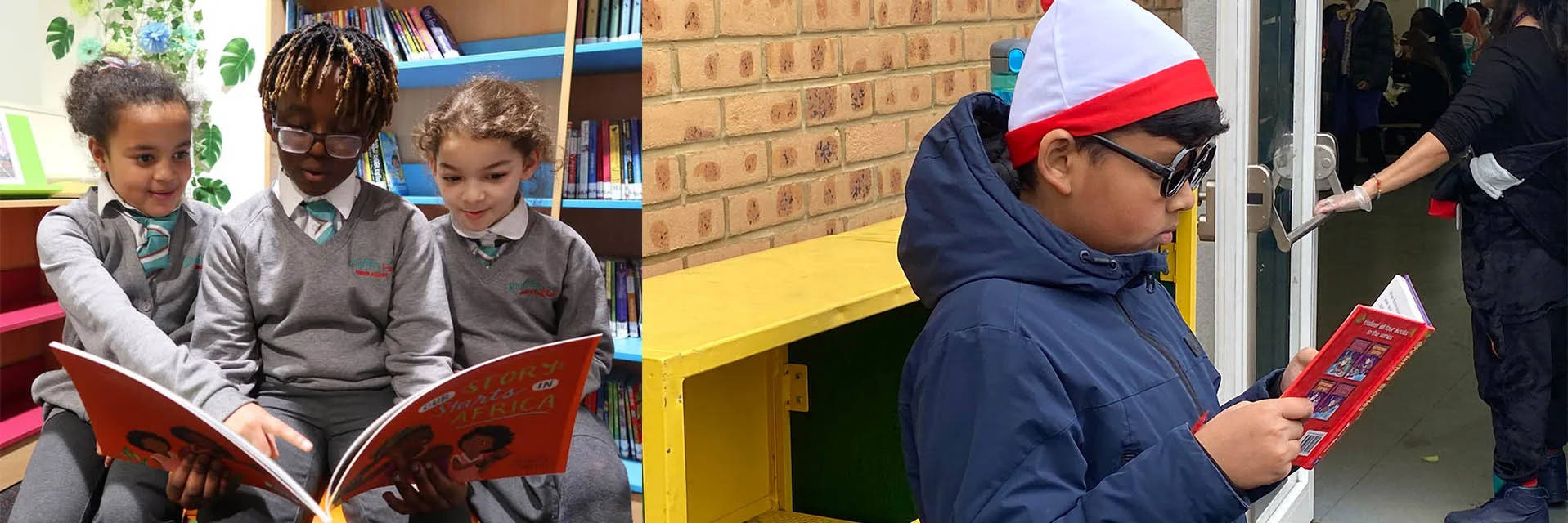
Reading Overview
At Kingfisher Hall, reading is taught step by step so that children steadily build their skills while also developing a genuine enjoyment of books. Our reading approach is organised into five connected areas: phonics, dialogic book talk, guided reading, whole-class reading, and a love of reading.
Each area is carefully planned so that children learn the reading skills and habits that match their age and stage. Clear assessment tools and shared reading expectations help teachers track progress and support every child’s development.
Phonics
In Reception and Key Stage 1, children follow a structured Read Write Inc. (RWI) phonics programme. This includes learning speed sounds, practising spellings, and developing reading fluency so that children can read with increasing confidence and accuracy. Families can also borrow books through the school’s Loaning Library in the main office to support reading at home.
Early Years – Book Talk (talking about stories together)
In the Early Years, children take part in regular book talk sessions where they look at and talk about stories together. These sessions help children enjoy books and learn new words that they may not hear in everyday conversation. Children also learn simple book skills such as how to hold a book, turn pages and follow the text from left to right.
Using pictures and key words, children talk about what a story might be about and share their own ideas. Teachers guide the discussion with gentle questions such as “I wonder…”, encouraging children to speak, listen and build longer answers. Sessions usually take place in small groups each week, with additional one-to-one reading in Reception matched to each child’s progress. The aim is to build confidence, communication skills and a lasting love of reading through high-quality books.
Years 1–2 (and Autumn Term Year 3) – Guided Reading
In guided reading, the teacher works with a small group to introduce the book and explain important new words, often using pictures to support understanding. Children then read quietly to themselves while the teacher listens to individual pupils read and asks questions to check their understanding. Simple reading strategies and classroom “reading tools” are used to help children break down and understand the text.
Alongside this, children take part in independent reading activities linked to what they are learning. These may include comprehension tasks, phonics practice, sequencing stories or listening to audio books. Children often work in pairs so they can talk about what they are reading and learn from each other.
Key Stage 2 – Whole-Class Reading
In Key Stage 2, children read and study a shared class book each half term. Where possible, this text links to other subjects so reading supports wider learning across the curriculum.
Each week focuses on a different reading skill so children build strong habits over time. These include predicting what might happen next, asking and answering questions, making links, understanding clues in the text, summarising key points and giving opinions about what they have read.
Teachers also show children practical ways to work out the meaning of new words, such as looking at root words, word type, using the surrounding sentence for clues and checking a dictionary.
Support is adapted to meet different needs. This may include short pre-teaching sessions, working with a partner or adult, online reading support such as Lexia, or small-group guided reading where appropriate.
Developing a Love of Reading
We provide many opportunities throughout the year to help children enjoy books and build a lifelong love of reading. Children meet visiting authors, take part in special author spotlight events and use well-stocked class libraries every day. Regular visits to the school library and the local community library encourage children to explore a wide range of books.
Reading is also celebrated through buddy reading with Heron Hall sixth-form students, outdoor reading activities, the Key Stage 1 Reading Caf?, and our popular Golden Ticket Reading Vending Machine, which rewards children for their enthusiasm and effort.
Reading Spine
We use a Reading Spine from Nursery to Year 6, which is a carefully chosen collection of books that teachers read to their classes at the end of the day. These stories are selected to introduce rich vocabulary, different story structures and time periods, and to encourage children to think deeply about what they read. The aim is to build enjoyment, confidence and a lasting love of books.
Our Reading Spine is informed by educational research and ensures that children experience a wide range of high-quality texts. Over time, this helps children build reading stamina, broaden their vocabulary and develop the skills they will need when they move on to secondary school.
What is Read Write Inc.?
Read Write Inc. (RWI) is a structured phonics programme that helps children learn to read quickly and confidently. It focuses on recognising letter sounds, blending sounds into words and improving spelling. Children are regularly assessed and taught in small groups matched to their stage of learning. Daily phonics lessons take place in Early Years and Key Stage 1 and are led by trained staff.
Phonics Screening Check
The Phonics Screening Check is a short national reading check that all children take in Year 1. During the check, children read 40 words aloud — 20 real words and 20 made-up “alien” words. The made-up words help teachers see how well children can sound out unfamiliar words using their phonics knowledge.
The check is completed one-to-one with the phonics lead teacher, usually in June. If a child does not reach the expected score, extra support is provided and the check is taken again in Year 2.
Watch a video about Read, Write, Inc
Read Write Inc. – Free resources for families
Welcome to the Read Write Inc. page on Oxford Owl, a great website packed with lots of free resources to help you at home.
Parents and carers can access 27 Read Write Inc. Phonics eBook titles for extra practice with their children at home, plus three Fresh Start Anthologies. 62 Speed Sound Practice Sheets are also available to download. Parents will need to create a free account on Oxford Owl for Home to access the eBooks. You can find all the resources here. Check out some fantastic free ebooks here.
We can achieve this together through:
• Read Write Inc, a programme to help your child learn to read
• Encouraging children to develop a love of books by reading to them daily; at home and at school
• Giving children access to a wide range of books at school and at home
You can find out more about how we teach reading in school in the section “Reading in School”
What is Read Write Inc?
Read Write Inc (RWI) is a phonics programme which helps all children learn to read fluently and at speed so they can focus on developing their skills in comprehension, vocabulary, and spelling. It also allows them to spell effortlessly so that they can put all their energy into composing what they write. The children are assessed by the RWI lead teacher and grouped according to their ability.
Small group phonics lessons are taught daily in Early Year and KS1 by trained staff and there are consistent expectations across the range of abilities. At the end of each half term the children are assessed to check on their progress and regrouped. We will support our most vulnerable readers with extra one-to-one teaching every day through high quality intervention using the RWI programme.
Children learn sounds in school which help them to read and write. They then practise these skills through reading their decodable phonics book and home reader matched to their ability at home, which are specifically pitched to both consolidate learning and provide challenge in an engaging and fun way!
Watch a video about Read, Write, Inc
Read Write Inc. – Free resources for families
Welcome to the Read Write Inc. page on Oxford Owl, a great website packed with lots of free resources to help you at home.
Parents and carers can access 27 Read Write Inc. Phonics eBook titles for extra practice with their children at home, plus three Fresh Start Anthologies. 62 Speed Sound Practice Sheets are also available to download. Parents will need to create a free account on Oxford Owl for Home to access the eBooks. You can find all the resources here. Check out some fantastic free ebooks here.
Ten great tips to encourage your child to read more
1. Create a Reading-Friendly Environment:
Set up a cozy reading corner in your home with comfortable seating, good lighting, and a variety of age-appropriate books within easy reach.
2. Be a Reading Role Model:
Let your child see you reading regularly. Children often imitate their parents, so if they see you enjoying books, they are more likely to develop a love for reading themselves.
3. Read Aloud Together:
Start reading aloud to your child from a young age. Even when they can read independently, continue this practice. It’s a great way to bond and share stories.
4. Visit the Library:
Take regular trips to the local library with your child. Let them choose their own books and explore different genres and topics.
5. Set a Reading Routine:
Establish a daily reading routine, such as bedtime reading. Consistency helps build good reading habits.
6. Choose Age-Appropriate Books:
Ensure that the books you select are appropriate for your child’s age and reading level. Ask librarians or teachers for recommendations if you’re unsure.
7. Explore Different Genres:
Encourage your child to explore a variety of genres, including fiction, non-fiction, fantasy, and poetry. This can help them discover their reading preferences.
8. Discuss What You Read:
After reading, engage your child in discussions about the book. Ask questions about the characters, plot, and their favorite parts. This helps with comprehension and critical thinking.
9. Use Technology Wisely:
While digital devices can be helpful for reading, ensure that screen time is balanced with physical books. E-books and audiobooks can also be great options.
10. Celebrate Reading Achievements:
Celebrate your child’s reading milestones, such as finishing a book, reaching a certain reading level, or participating in reading challenges.
Positive reinforcement can motivate them to read more.Remember that the goal is to make reading a fun and enjoyable activity for your child. By following these tips and fostering a positive reading environment at home, you can help your child develop a lifelong love for reading.

About the Read Aloud Initiative
We believe that reading aloud is a powerful tool for nurturing young minds. Here’s what the Read Aloud Initiative is all about:
Building Strong Foundations: Reading aloud helps children develop crucial language and literacy skills from an early age. It enhances vocabulary, comprehension, and listening skills.
Fostering a Love for Books: We want to instill a passion for reading in our students. Through engaging stories and interactive sessions, we hope to make books their lifelong companions.
Creating a Bond: Reading aloud is a wonderful way for parents, guardians, and teachers to bond with children. It creates lasting memories and deepens relationships.
Why Read Aloud Matters
Boosts Academic Performance: Studies show that students who are read to regularly perform better in school. Reading aloud sets the foundation for academic success.
Enhances Imagination: Books take us to different worlds and ignite the imagination. Children who are read to are more creative and imaginative.
Improves Concentration: Listening to stories improves a child’s attention span, a valuable skill both in school and everyday life.
Builds Empathy: Through stories, children learn about different cultures, experiences, and perspectives, fostering empathy and understanding.
Get Involved
We invite parents, teachers, and students to get involved in our Read Aloud Campaign:
Read Aloud at Home: Spend quality time with your child by reading books together. It’s a bonding experience that they will cherish.
Volunteer: Details to be announced.
Book Donations: Help us build a diverse library for our students by donating books or funds to purchase new ones.
Resources:
Explore the following resources to make the most of the Read Aloud Initiative:
Reading List: Find a curated list of age-appropriate books for your child on our website when we relaunch Read Aloud in November.
Tips for Effective Read Aloud: Learn how to make your read-aloud sessions engaging and enjoyable for your child. New resources coming soon when we relaunch Read Aloud in November.
Join us in creating a community of avid readers through the Read Aloud Initiative.
Together, we can inspire a lifelong love for reading in our young learners.
Free resources
Our goal is to empower you with practical strategies and creative ideas to make reading a delightful and regular part of your family’s routine. From selecting the right books to creating engaging reading environments, we cover all aspects to make reading an adventure that your child looks forward to every day.
We believe that every child is unique, and our resources are tailored to meet diverse needs and interests, ensuring that there’s something for every young reader.
Join us as we explore the wonderful world of books, unlocking the magic of words and imagination.
Let’s turn the page together and embark on a journey that not only enhances reading skills but also builds a foundation for lifelong learning and curiosity.